Why You Feel Lonely Even Around People
Posted in :

Why You Feel Alone Even When You’re Not
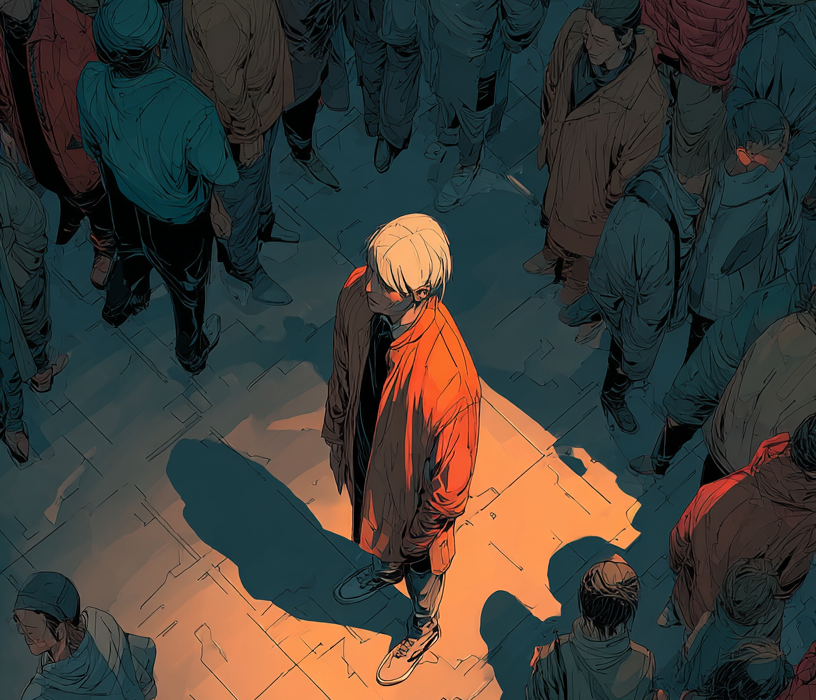
You can be surrounded by people and still feel completely unseen. You can be in a relationship, at a party, mid-conversation — and still feel that specific kind of loneliness that has nothing to do with proximity. If you’ve felt that, you already know it’s one of the harder things to explain. And one of the harder things to fix, because the usual advice — put yourself out there, be more open, try harder — doesn’t touch what’s actually going on.
The Picture You’re Attached To
Most people who struggle with loneliness aren’t struggling because love is absent from their lives. They’re struggling because reality keeps failing to match a picture they carry internally — a picture of how love should feel, how it should arrive, how it should look when it finally works. And every time a connection falls short of that picture, the conclusion drawn is a personal one: something is wrong with me.
Carl Jung understood this dynamic better than most. He observed that we are drawn to people who mirror the parts of ourselves we haven’t yet healed — not consciously, not deliberately, but through the deep pull of familiarity. The nervous system doesn’t seek what’s healthy. It seeks what it recognizes.
Attached by Amir Levine and Rachel Heller maps this in precise, readable terms — it’s the clearest modern framework for understanding why you keep gravitating toward the same emotional dynamics even when you can see, intellectually, that they aren’t working.
Why the Wrong Person Feels Like the Right One
Nietzsche believed that patterns repeat until the person becomes strong enough to break them. Put that alongside Jung’s insight and a clear picture emerges: you don’t attract what you want. You attract what feels familiar. And familiarity, in the emotional body, registers as rightness — as chemistry, as intensity, as recognition.
If chaos was familiar in your early life, chaos in a relationship reads as passion. If emotional distance was the norm, someone who pulls away feels intriguing rather than alarming. The nervous system isn’t making a mistake. It’s doing exactly what it was trained to do — find the pattern it knows.
This is why the person who feels electric often turns out to be the person who mirrors an unresolved wound. And why the person who feels “too stable,” “too available,” or “too calm” can feel, at first, like something is missing. Nothing is missing. The wound just isn’t being activated, and the wound had learned to call that feeling love.
What Loneliness Is Actually Filtering For
There’s a reframe worth considering: loneliness isn’t evidence of failure. It’s evidence of increasing specificity. When shallow connections no longer satisfy — when you can sit in a crowded room and feel nothing — it often means your capacity for real depth has outgrown your current environment. You’re not broken. You’re becoming harder to fool.
The people who seem to find connection easily are often people who have settled for proximity in place of intimacy. They are surrounded, but not necessarily known. The loneliness you feel might be the cost of refusing to do that — of holding out for something that actually reaches you, even when you’re not sure it exists.
The Shift That Changes What You Attract
Healing doesn’t announce itself dramatically. It shows up in smaller ways: the person who once felt electric starts to feel exhausting. The one who seemed too stable starts to feel safe. The pull toward intensity quietly loses its grip, and something steadier starts to seem worth having.
This shift doesn’t happen through effort alone. It happens through self-awareness — through seeing the pattern clearly enough that it loses its unconscious power. The moment you recognize that attraction is a map of your inner world, and not a verdict on your future, something opens up.
The Art of Loving by Erich Fromm is a book that asks a question most people never seriously consider: what if love is not something that happens to you, but something you practice? It reframes the entire search — away from finding the right person, and toward becoming someone with the capacity for real connection.
The right person doesn’t show up when you try harder. They show up when you stop abandoning yourself in order to feel chosen. And the moment you understand your patterns well enough to stop mistaking your wounds for your soulmate, the loneliness changes shape entirely.
The full reading list for this topic is at themindofthemasters.com — every book mentioned here, organized by theme.